VitreousAI is the real-time containment layer that makes enterprise AI agent reasoning visible and interceptable before execution. Not after.
The Problem
Enterprises are deploying autonomous AI agents to run operations, handle financial transactions, and manage live data pipelines. The tools to build those agents are mature. The tools to contain them are not.
Current guardrails are passive. They filter inputs and outputs. They do not watch an agent reason its way toward a bad decision in real time. By the time a log file surfaces the problem, the damage is done.
This is why legal and security teams at major enterprises are blocking agentic AI deployments right now. Not because the technology does not work. Because nobody can see inside it while it works.
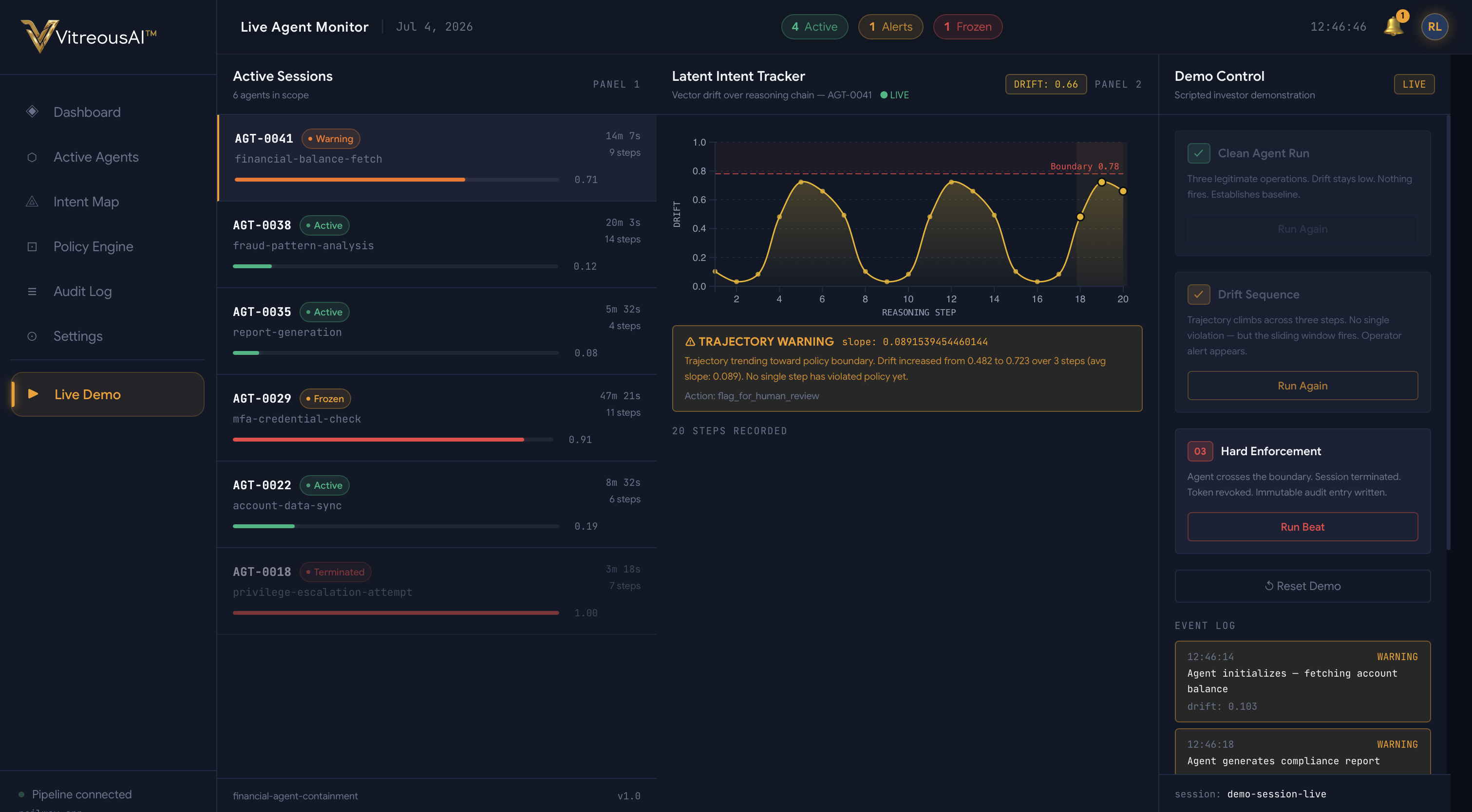
Over a sequence of steps, an agent slowly reasons its way toward an unauthorized action. No single step triggers a rule. The policy violation is the trajectory, not the step. Passive filters miss it entirely.
An agent uses legitimate access in one domain to chain tool calls into systems outside its assigned scope. Static permission sets do not account for dynamic multi-hop sequences in a live session.
An agent repeats a failed tool call indefinitely, burning compute budget and degrading live systems. Logging captures the event. It has no mechanism to interrupt execution before the damage accumulates.
How It Works
VitreousAI sits between your orchestration framework and your model inference layer. It intercepts the communication stream, maps agent reasoning trajectory in real time, and enforces policy boundaries at the moment of decision. Not after the fact.
The Glass Wall Framework
VitreousAI is built on the Glass Wall Framework, an original methodology for real-time agentic containment published in June 2026. The framework operates through three coordinated engines, each addressing a distinct failure vector.
Evaluates where your agent is going, not just what it is doing. Maps the semantic vector trajectory of the agent's reasoning chain across multiple steps. Flags drift before any single step has technically violated a rule.
Catches: Cognitive DriftGenerates dynamic, session-scoped execution credentials for every agent task. An agent cannot chain tool calls to reach systems outside its assigned scope because no such access exists in its session context.
Catches: Privilege EscalationEstablishes a behavioral baseline for every agent and monitors for statistical deviation in real time. Tracks tool-calling cadence, token consumption, and state transition patterns against the established norm.
Catches: Runaway LoopsEnforcement
VitreousAI does not respond to all violations the same way. The intervention response scales with detection severity. Legitimate agent operations keep running. Credible threats receive immediate hard enforcement.
Minor vector divergence or repetitive step patterns detected. The proxy writes a system note back to the agent prompting self-correction. No human involvement required.
Unauthorized tool invocation outside current session scope. Execution pauses, session state is preserved, and a human administrator is alerted for approval before resuming.
Hard blacklist match or confirmed malicious intent via cognitive drift analysis. Session terminated, tokens revoked, and an immutable audit record generated immediately.
As enterprise AI moves from assistants to autonomous workers, the infrastructure that safely contains and visualizes agent behavior will be worth more than the agents themselves.
The Glass Wall Framework — Rocky Lindley, June 2026
Early Access
VitreousAI is currently in development with a limited pilot program opening later this year. If you are deploying autonomous agents in a production environment and the containment problem is real for your organization, we want to talk.